

Have you ever rated your satisfaction at the touch of a button at a feedback terminal in an airport, at a checkout, or in public bathrooms?
What appears playful from the user's perspective is based on a well-thought-out IoT architecture. The devices, most of which are battery-powered, send their status messages over a period of months to a central receiving point, which processes the received data in real time without a Wi-Fi or cellular connection. The underlying technology is LoRaWAN.

With the increasing level of connectivity in infrastructure as part of digital transformation programs, there is a growing need for energy-efficient and cost-effective scalable communication technology that can reliably transmit data even outside traditional IT environments.
LoRaWAN (Long Range Wide Area Network) was designed precisely for this purpose: as an open transmission standard for transferring small amounts of data over urban distances.
The technology is particularly suitable for battery-powered devices that record measured values and transmit them at low transmission rates. Standardized interfaces allow an unlimited number of sensors and actuators to be integrated into existing IT and operating infrastructures.
LoRaWAN provides the TTL industry (Travel, Transport & Logistics) with a resilient, flexible, and future-proof technology that makes it economically feasible to get started with or expand IoT-based operational optimization.
LoRaWAN is based on the principle of Low Power Wide Area Networks (LPWAN). Data is transmitted with extremely low transmission power via the license-free sub-gigahertz frequency band (e.g., 868 MHz in Europe).
It is remarkable that the underlying modulation technique is inspired by nature. Signals consist of (up/down) chirps and continuous frequency sweeps (rising/falling), which dolphins and bats, for example, use to communicate and locate prey.
The modulated LoRa signal is transmitted over a wide frequency spectrum, making it resistant to disruptive interference. LoRa's bandwidth is typically 125 kHz; by comparison, FM radio has a bandwidth of only 12–16 kHz.
The LoRaWAN network architecture is modular and scalable, consisting of four main components:
End devices, sensors with integrated LoRaWAN links, measure and transmit data such as meter readings, temperature, or coordinates. They transmit their data by communicating with the gateways.
The Gateways act as receivers and bridges to the network (Internet/intranet). They transmit received signals to the network server via IP-based connections (LAN,Wi-Fi, cellular).
The connected Network Server takes over central control. As in a postal office, it checks for redundancies, manages security, and prioritizes transmission of data to downstream systems.
Final processing takes place on the Application Server. Here, the sensor data is decrypted and made available as data for applications. This data can then be used either directly or in combination with other data sources.
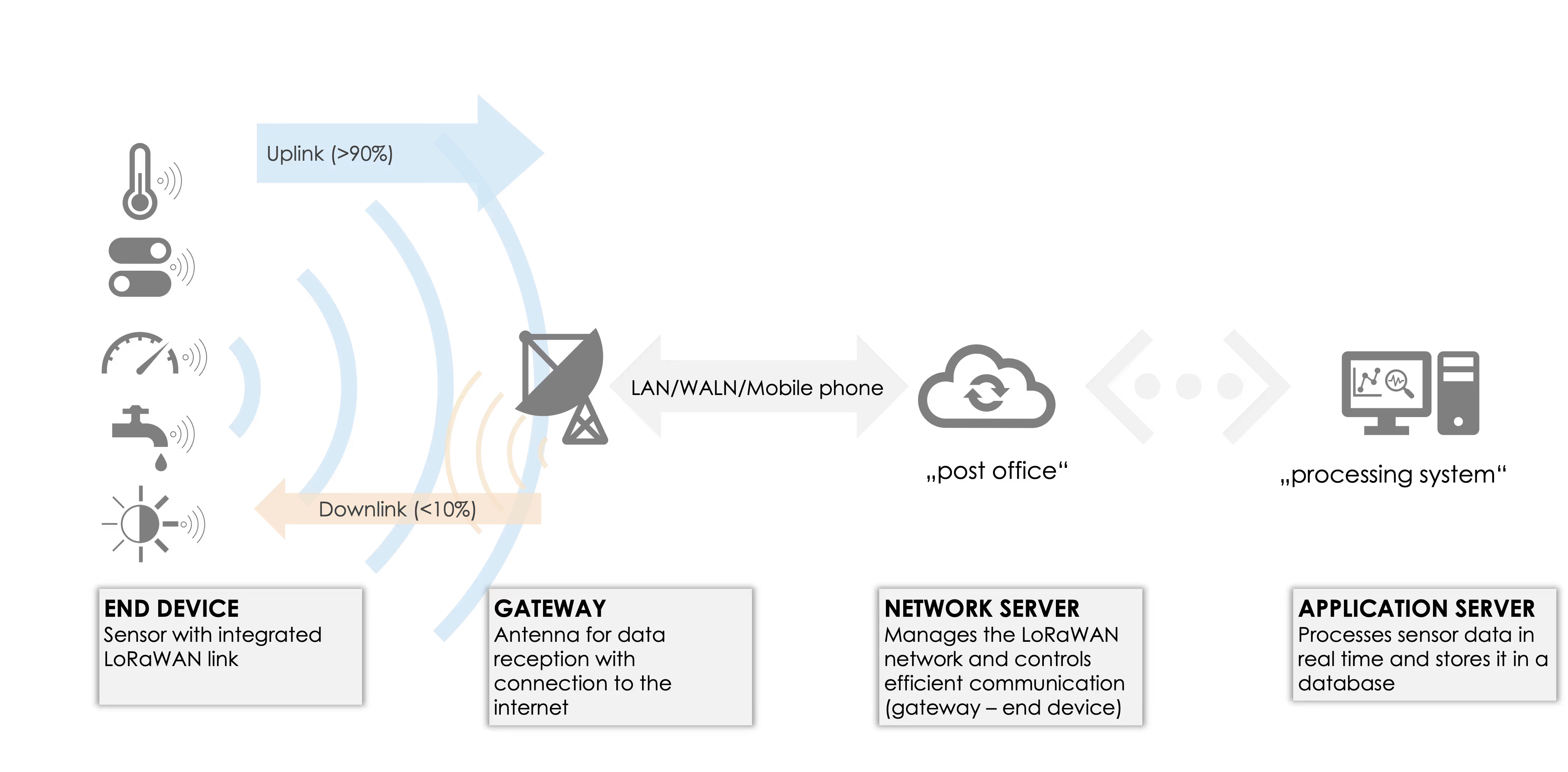
Even though communication is generally directed from end devices to gateways (uplink), communication in the direction of individual devices (downlink) is possible, for example for configuration purposes.
Despite using license-free frequency bands, LoRaWAN offers a high level of security. Communication is encrypted end-to-end (AES-128 encryption). Each device has individual keys that ensure secure authentication, integrity, and confidentiality. Even if radio traffic were to be intercepted, the content would remain protected because the signals are inaccessible without a valid key.
With the continuous development of new sensor technology for LoRaWAN, the number of specific use cases is also increasing. This is particularly the case in locations such as transport hubs, where processes are driven by efficiency or security procedures are controlled on the basis of data. The possible applications range from simple fuel level sensors to the intelligent networking of infrastructure across entire terminal areas.
M2P has compiled a selection of proven use cases with a focus on facility management. The examples show how companies can increase their operational efficiency and enhance operational security through targeted use.

LoRaWAN is not a replacement for Wi-Fi or 5G, but rather a complementary signal processing technology with a different purpose: While Wi-Fi and 5G are designed for high bandwidths and low latency for large data volumes (e.g. video streaming or voice transmission), LoRaWAN focuses on the energy-efficient transmission of small data packets over long distances. Ideal for sensors that transmit data periodically or on an event-based basis.
LoRaWAN enables simple and cost-effective networking without cabling, where traditional technologies would either be oversized or economically unattractive.
To avoid challenges, M2P Insights has compiled a list of factors that must be taken into account during planning:
LoRaWAN is more than just another wireless technology. It is an enabler for data-based operational management. License-free data transmission, wireless devices, and simple installation make the solution particularly attractive for large-scale infrastructures such as airports, train stations, or industrial areas.
However, the real added value only comes into play when the technology is used in a targeted manner. The focus is not on the technology itself, but on specific use cases with leverage on costs, efficiency, and security.
Get in touch with our expert team to explore how we can help your organization become fit for the future.